
 Healthcare Is Becoming Expensive in India:
Can an Ordinary Middle-Class Family Afford a Major Hospitalisation Without Health Insurance?
The day a medical emergency changes a family’s financial life
Imagine a family living in Bhubaneswar.
The husband works in a private company, the wife manages the household, and they have two children. They earn a reasonable monthly income. They have purchased a house, are paying a home loan EMI, investing in mutual funds and saving for their children’s education and retirement.
They believe they are financially responsible.
One morning, the husband experiences severe chest pain. His family rushes him to a hospital. After medical investigations, doctors recommend an immediate cardiac procedure.
The family is suddenly confronted with a hospital estimate of ₹4–6 lakh.
They have some savings, but most of their money is invested for long-term goals. Their monthly income is already committed to household expenses, EMIs and investments.
What should they do?
Should they break their investments? Borrow money from relatives? Take a personal loan? Or compromise on the hospital or treatment?
This is not an imaginary financial problem. Thousands of Indian families face similar situations every year.
We spend years working hard, earning money, purchasing assets and building investments. But sometimes, one serious illness can put years of financial discipline under pressure.
The question is not whether we can afford to buy health insurance today. The more important question is whether we can afford a major medical emergency tomorrow without it.
Healthcare costs have changed dramatically between 2016 and 2026
Ten years ago, many middle-class families believed that ₹2–3 lakh in savings would be sufficient for most medical emergencies.
That assumption has become increasingly difficult to justify.
Medical technology has improved, specialised hospitals have expanded, and access to advanced treatments has increased. However, the cost of treatment has also risen substantially.
According to a Policybazaar analysis of medical expenses published by Moneycontrol in May 2025, several common surgical procedures became approximately 250–300% more expensive over the period examined.
Look at the following comparison.
Comparison of selected treatment and surgery costs
Indicative Indian treatment-cost estimates, in ₹ lakh. 2025 is the latest comparable year in this particular dataset, used as a practical 2026 planning reference
|
Treatment / surgery |
2016 | 2025 |
Approx. increase |
| Cataract surgery |
0.35 |
1.26 |
260% |
| Appendix surgery |
0.45 |
1.58 |
251% |
| Hernia surgery |
0.40 |
1.41 |
253% |
| Knee replacement |
2.00 |
7.03 |
252% |
| Angioplasty |
0.70 |
2.46 |
251% |
These figures are based on Policybazaar’s internal medical-cost analysis reported by Moneycontrol. They are not fixed hospital tariffs and actual costs vary by hospital, city, treatment method and patient condition.
For more serious medical conditions, the financial impact can be even greater.
Major illnesses and advanced treatment costs
|
Treatment |
2016 estimate |
2024 estimate |
| Cancer treatment |
₹18.8 lakh |
₹50.8 lakh |
| Heart transplant |
₹13.3 lakh |
₹34 lakh |
| Liver transplant |
₹9.5 lakh |
₹24.3 lakh |
| Kidney transplant |
₹7 lakh |
₹18.2 lakh |
These are indicative figures from the same reported claim analysis, not guaranteed costs for an individual patient. Cancer treatment costs, in particular, depend heavily on the cancer type, stage, treatment duration and combination of therapies.
Think about this for a moment.
A treatment that cost around ₹2 lakh in 2016 may require more than ₹7 lakh today. A serious cancer treatment may involve expenses running into tens of lakhs.
Can an ordinary middle-class family arrange such an amount immediately without disturbing its financial goals?
That is the reality we must recognise.

Medical inflation: A financial risk that families often ignore
Most people understand general inflation.
They know that groceries, petrol, school fees, transportation and household expenses become more expensive over time.
But healthcare inflation deserves special attention.
According to Milliman’s April 2026 analysis, medical-cost trends in India reached approximately 12% in 2024 and were projected at 13% for 2025. These figures are considerably higher than the general inflation rate cited in the same analysis.
Another analysis published in a 2026 SEBI report, citing Frost & Sullivan, showed average healthcare inflation of 11.2% during 2018–2025.
What does this mean for an ordinary family?
Suppose a medical procedure costs ₹5 lakh today.
If medical expenses increase by 12% every year, the same treatment could cost approximately:
After 5 years: ₹8.81 lakh
After 10 years: ₹15.53 lakh
After 15 years: ₹27.37 lakh
This is an illustration using a constant 12% annual increase, not a prediction of an actual hospital bill.
The lesson is important.
We plan our retirement considering inflation. We plan our children’s education considering inflation. But do we plan our future healthcare expenses considering medical inflation?
If not, we are leaving an important part of our financial future unprotected.
What does this mean for families in Odisha?
Let us bring this discussion closer to home.
Whether a family lives in Bhubaneswar, Cuttack, Puri, Sambalpur, Berhampur, Balasore or a smaller town in Odisha, the financial consequences of a serious illness can be significant.
Families in Bhubaneswar and Cuttack have access to several multi-speciality private hospitals and advanced medical facilities. Patients from other districts often travel to these cities for specialised treatment.
But treatment expenses do not stop at the surgeon’s fees.
A hospital bill may include:
- Doctor and specialist consultation fees.
- Surgery and operation theatre charges.
- Medicines, consumables and medical equipment.
- Diagnostic tests and investigations.
- Implants, stents and other medical devices.
- Post-surgery care and rehabilitation.
There may also be expenses for accommodation, travel and food when family members accompany a patient from another district.
For an Odisha middle-class family, even a ₹3–5 lakh hospital bill can create substantial financial pressure. A prolonged hospitalisation or complicated surgery can make the situation much more difficult.
The earlier comparison provides useful planning benchmarks for families in Odisha, but these are India-wide estimates, not verified Bhubaneswar or Odisha hospital quotations. Actual treatment costs should always be obtained directly from the hospital.
We must also recognise the role of government healthcare facilities and public health protection schemes. Eligible families should check their entitlement under applicable Odisha and central government health schemes, including the current Gopabandhu Jan Arogya Yojana and Ayushman Bharat arrangements.
These schemes can provide valuable support. However, families should understand eligibility, covered treatments, hospital networks and applicable limits rather than assume every treatment and hospital expense will be covered.
Why is health insurance important for every family?
Health insurance is often treated as an unnecessary expense.
People ask:
“I am healthy. Why should I pay a premium every year?”
“My employer already provides medical insurance.”
“I have ₹5–10 lakh in my bank account. Why do I need another insurance policy?”
These questions are understandable, but they overlook an important financial principle.
Insurance is not purchased because we expect something bad to happen. It is purchased because we cannot predict when a financial emergency will occur.
Let us understand its importance.
First, it protects your savings and investments.
Suppose you have accumulated ₹25 lakh through years of disciplined investments for your children’s education, retirement and other family goals.
A major medical emergency may require ₹8 lakh.
Without adequate insurance, you may have to withdraw money from your investments, disturb your financial plans or sell assets at an unfavourable time.
Health insurance can help protect these long-term investments by covering eligible hospitalisation expenses.
Second, it reduces dependence on loans and relatives.
No family should have to spend precious time arranging money when someone they love is fighting for their life.
An adequate health insurance policy with cashless hospitalisation facilities can reduce the immediate financial burden, subject to policy terms and hospital network availability.
Third, it provides financial confidence.
A family should be able to focus on treatment, recovery and emotional support rather than worrying continuously about arranging money.
That peace of mind is an important part of financial security.
Fourth, it becomes increasingly important as we grow older.
As people age, the possibility of requiring hospitalisation and specialised treatment generally increases.
Unfortunately, purchasing health insurance for the first time at an older age may be more expensive and can involve medical underwriting, exclusions or waiting periods.
Therefore, buying appropriate coverage when we are younger and healthier is generally a sensible decision.
How much health insurance should a middle-class family have?
There is no single amount that is suitable for every family.
A young family living in Bhubaneswar with two children may have different requirements from a 55-year-old couple living in a smaller town.
However, considering current treatment costs and medical inflation, families should review whether their existing coverage is adequate.
For example, a family may evaluate:
- Individual or family-floater health insurance.
- A base health insurance cover, perhaps ₹10–15 lakh, depending on its circumstances.
- A super top-up policy to increase protection at a relatively affordable additional premium.
- Separate consideration of parents’ healthcare requirements.
- Suitable coverage for critical illnesses and other specific needs, where appropriate.
These are planning illustrations, not universal recommendations.
Before purchasing a policy, examine the following carefully:
- Pre-existing disease waiting periods.
- Room-rent restrictions and disease-wise sub-limits.
- Co-payment clauses and deductibles.
- Cashless hospital network, particularly in Odisha.
- Day-care and modern treatment coverage.
- Restoration benefits and exclusions.
- Claim settlement conditions and policy continuity.
Do not select a health insurance policy simply because its premium is low.
A cheaper policy that does not provide adequate protection when you need it may not serve your purpose.
Also, remember that health insurance does not necessarily cover every rupee of every hospital bill. Read the policy wording and understand the conditions before purchasing.
Your employer’s health insurance may not be enough
Many salaried professionals depend entirely on their employer-provided medical insurance.
It may provide valuable protection while they are employed.
But what happens when they change jobs, take a career break, become self-employed or retire?
The coverage may stop or change.
Moreover, the employer’s sum insured may not be sufficient for a major illness involving several hospitalisations or expensive treatment.
Therefore, having an independent personal health insurance policy can be an important part of family financial planning.
Do not wait until retirement to think about this.
Health insurance is a family responsibility, not just an individual decision
In many Indian families, one person earns the income and takes responsibility for investments, savings, EMIs and children’s education.
But financial responsibility should not end with wealth creation.
It should also include protecting the family’s health and financial future.
Husband and wife should discuss their health insurance arrangements together. They should know the policy details, insurer’s contact number, hospital network and claim procedure.
Parents should also discuss healthcare protection with their adult children.
A medical emergency is already emotionally difficult. The family should not have to discover for the first time that its insurance coverage is inadequate.
A financial planner’s perspective: Protect first, then build wealth
In financial planning, we often discuss savings, investments, retirement planning, children’s education and wealth creation.
But wealth creation without risk protection can leave a family financially vulnerable.
Imagine spending 20 years building a retirement corpus of ₹1 crore, only to withdraw a substantial amount because of an unexpected medical emergency.
The loss is not limited to the hospital bill. It can also affect future investment growth, retirement income and the family’s financial independence.
This is why financial planning must consider both wealth creation and wealth protection.
Health insurance, life insurance, an emergency fund and disciplined investments serve different purposes. One cannot replace the other.
Health insurance is not an investment that should be judged by how much money you receive back. Its purpose is to transfer a defined portion of the financial risk of eligible medical expenses to an insurer.
And that protection can become extremely valuable when your family needs it most.
“Good health is not something we can buy. However, it can be an extremely valuable savings account.” ~Anne Wilson Schaef
One question every family in Odisha and India should ask
Let me leave you with a few questions.
If you or your spouse needs a major operation tomorrow, can your family arrange ₹5 lakh, ₹10 lakh or ₹20 lakh without taking a loan or disturbing long-term investments?
Are your parents adequately protected?
Is your employer’s health insurance sufficient?
Have you reviewed your health insurance coverage in the last two or three years?
Do you know which hospitals in your city offer cashless treatment under your policy?
If you do not know the answers, perhaps it is time to review your family’s financial protection.
We cannot control every illness. We cannot predict every medical emergency. And we cannot stop healthcare costs from increasing.
But we can prepare ourselves financially.
Remember, earning money is important. Saving money is important. Investing money is important. But protecting the money you have worked so hard to create is equally important.
A medical emergency should never become a reason for a family to abandon its dreams, compromise on its children’s future or lose its retirement security.
Let us not wait for a hospital admission to understand the value of health insurance.
Let us make financial protection a priority today.
Because true financial prosperity is not just about how much wealth you create. It is also about how well you protect your family when life takes an unexpected turn.
Stay financially prepared. Stay protected. Keep moving!
About the Author
RUPAKUMAR PRADHAN, CFP®, CWM®
Chief Financial Planner & Founder, SmartMantra Financial Services Pvt. Ltd. | HappyMoney Coach | Author of JOYFUL RETIREMENT
Rupakumar Pradhan is a CERTIFIED FINANCIAL PLANNER® and CHARTERED WEALTH MANAGER® with 28 years of experience in financial planning and wealth management.
Through his professional practice, writing, teaching and financial education initiatives, he helps individuals, families, professionals, business owners and NRIs make informed financial decisions and work towards financial prosperity and peace of mind.
His philosophy is simple: Financial planning is not just about creating wealth. It is about creating a life with financial confidence, security and peace of mind.
He believes in helping people move towards their HappyMoney Zone.
Connect with Rupakumar:
Personal website: https://www.rupakumarpradhan.com
Professional contact: https://www.rupakumarpradhan.com/contact/
Learn about SmartMantra: https://smartmantra.in
SmartMantra Financial Services Pvt. Ltd.
Future, Designed Around You.
SmartMantra is a Bhubaneswar-based financial planning and wealth management firm committed to helping individuals and families achieve their financial goals through structured financial planning and personalised guidance.
An AMFI Registered Mutual Fund Distributor | ARN-167331.
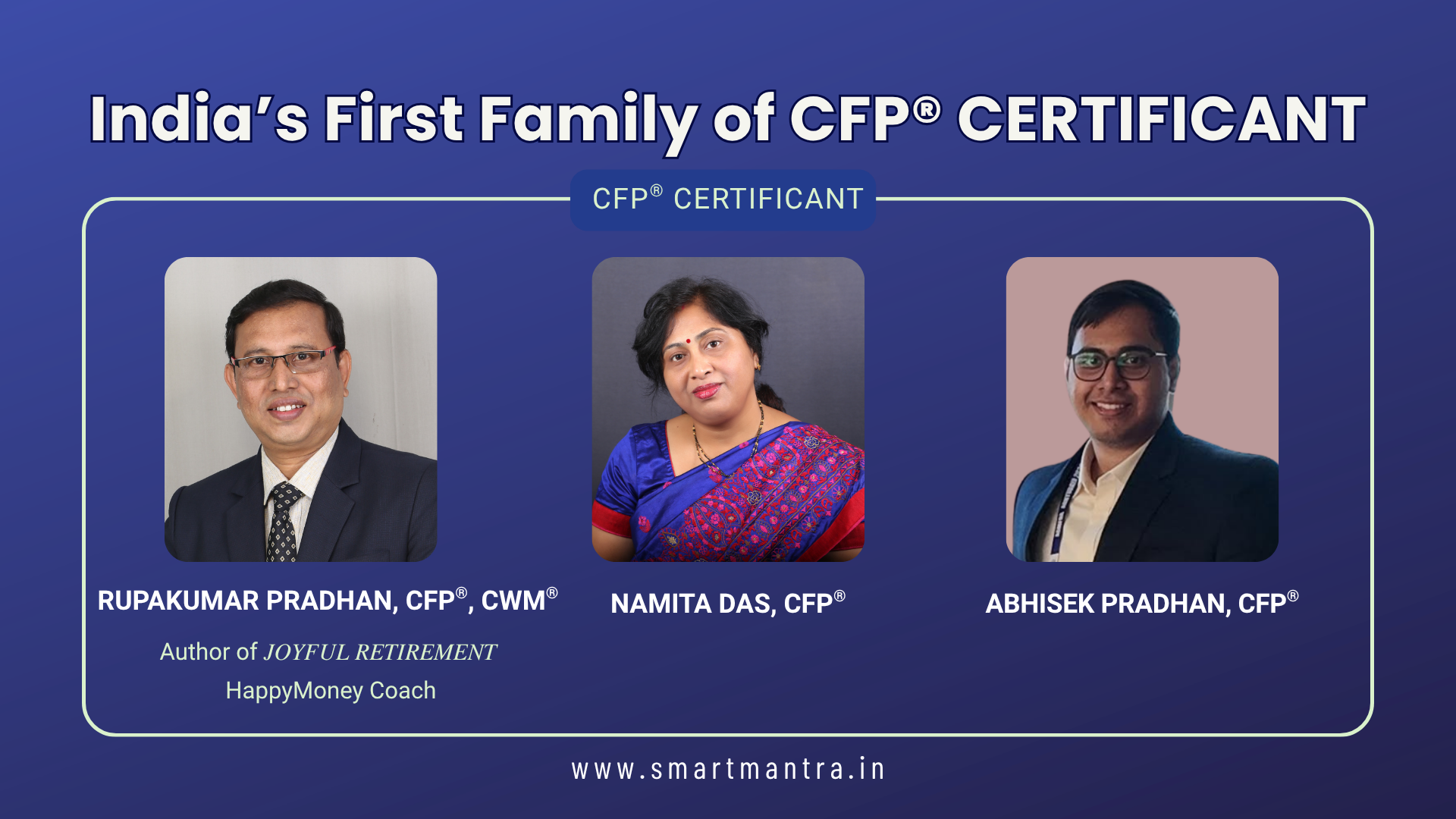
India’s First Family of CFP® Certificant
Rupakumar Pradhan, CFP®, CWM® | Namita Das, CFP® | Abhisek Pradhan, CFP®
A family united by a shared commitment to financial planning, professional learning and financial empowerment.
Keep moving towards a financially peaceful life!
Disclaimer: This article is intended for general educational and informational purposes only. It should not be construed as personalised financial, investment, insurance, tax or legal advice. Financial decisions should be made after considering individual circumstances, financial objectives and risk tolerance. Where applicable, mutual fund investments are subject to market risks. Please read all scheme-related documents carefully before investing.
ଅବସର ପରେ କେମିତି କାଟିବ ସମୟ? ଅବସର ପୂର୍ବରୁ ନିଜକୁ ଏହି ପ୍ରଶ୍ନ ପଚାରିଛନ୍ତି କି?, Read it.